Medically reviewed by Dr. Venkatesh Mishra — MPT (HNB Garhwal University), MSc Osteopathy, Master of Chiropractic (Stockholm), Certified Dry Needling Practitioner. 19+ years in musculoskeletal and sports rehabilitation. Founder, VS Physiotherapy, Osteopathy & Chiropractic Clinic, Kalyanpur West, Lucknow.
You went for an MRI after your knee gave way during a cricket match, a fall on the stairs, or a bike skid on the Ring Road. The report says “ACL tear.” The first advice you probably received was surgery, ACL reconstruction, ₹1.5–3 lakh, six to nine months out of action.
Here is what most patients in Lucknow are never told: surgery is not the only path, and for a significant number of people, it is not the first path. A well-designed rehabilitation programme can restore a stable, functional, pain-free knee in many ACL injuries, particularly partial tears, and even in a meaningful proportion of complete tears in patients who meet specific clinical criteria.
This guide explains exactly when non-surgical ACL treatment works, when it does not, how long recovery actually takes, and what a structured knee rehab programme looks like at our clinic in Kalyanpur West, Lucknow.
Can an ACL Tear Heal Without Surgery?
Yes, many ACL tears can be managed successfully without surgery. Whether yours can depends on three things: the grade of the tear, the stability of your knee once swelling settles, and the demands you place on that knee in daily life and sport.
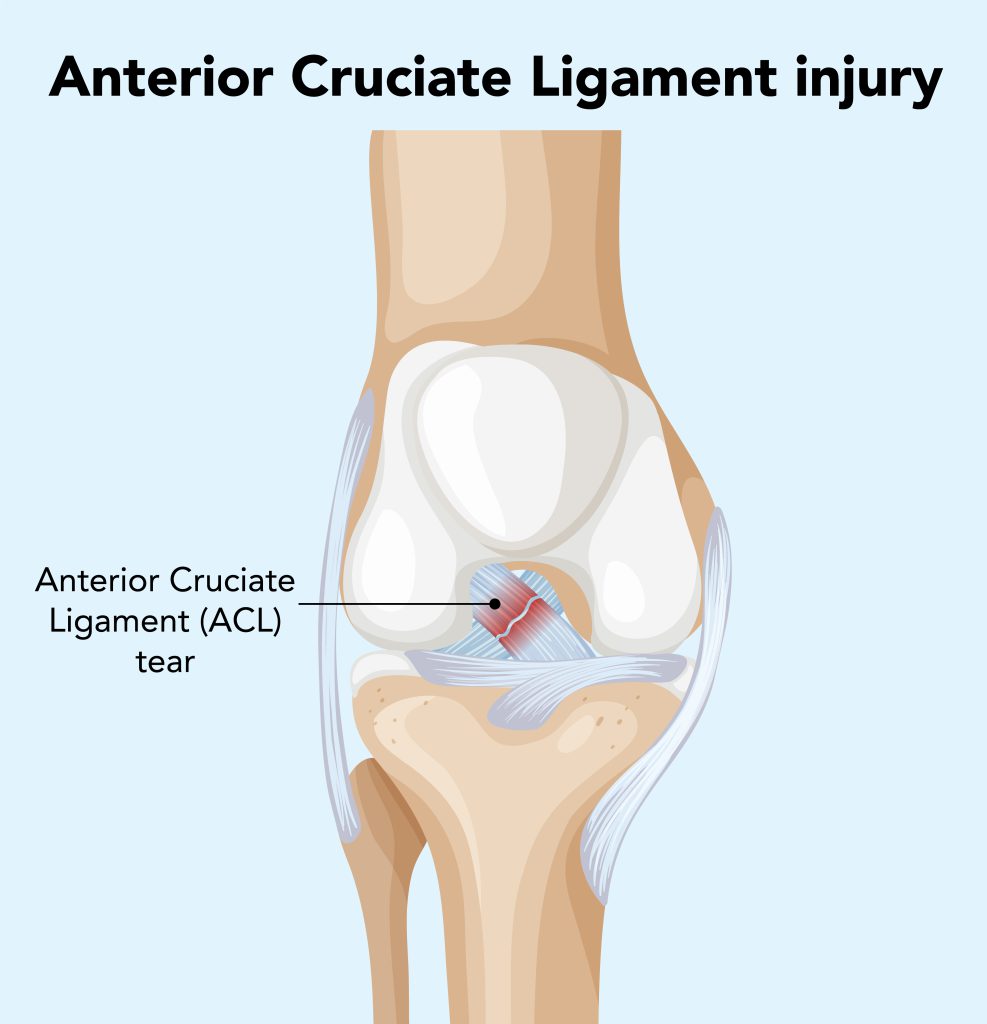
The ACL (anterior cruciate ligament) sits deep inside the knee joint and stops the shin bone sliding forward on the thigh bone. When it tears, the joint can feel like it “gives way” on turning or pivoting. But the ACL is not the only structure controlling that movement. Your hamstrings, quadriceps, calf, hip stabilisers and the joint’s own position-sense receptors all contribute. Rehabilitation works by training those systems to compensate, restoring functional stability even when the ligament itself has not been reconstructed.
Patients who achieve a stable, symptom-free knee through rehab alone are described in sports medicine as “copers.” Those who continue to experience episodes of the knee buckling despite good rehab are “non-copers”, and for that group, surgical reconstruction is usually the correct answer.
The critical point: you cannot know which group you belong to from an MRI report alone. It is determined by a structured trial of rehabilitation and objective testing which is precisely what a specialist physiotherapy assessment provides.
Grade of Tear: What Your MRI Report Actually Means
| Grade | What it means | Non-surgical outlook |
| Grade 1 (Sprain) | Ligament stretched, fibres intact | Excellent — rehab is the standard treatment |
| Grade 2 (Partial tear) | Some fibres torn, ligament partly intact | Very good — most partial tears are managed non-surgically |
| Grade 3 (Complete tear) | Ligament fully ruptured | Variable — depends on knee stability, activity demands and associated injuries |
Partial ACL tear treatment without surgery
Partial tears are the strongest candidates for non-surgical management. With intact fibres still providing some restraint, a progressive strengthening and neuromuscular programme usually restores full function. Surgery for partial tears is comparatively uncommon.
Complete ACL tear treatment without surgery
A complete rupture does not automatically mean the operating theatre. Non-surgical management is a genuine option when:
- Your knee is stable on clinical testing after swelling settles
- You do not have a significant associated meniscus or multi-ligament injury
- Your activity demands are low-to-moderate — walking, gym work, cycling, swimming, desk work, household activity
- You respond well to an initial 8–12 week rehabilitation trial
Non-surgical management is generally not appropriate for competitive athletes in pivoting sports (football, kabaddi, badminton, basketball), for knees that keep giving way despite rehab, or when a locked knee suggests a displaced meniscus tear requiring surgical attention.
ACL Tear Recovery Time Without Surgery
Recovery is measured in phases, not a single date. Here is the realistic timeline for a structured non-surgical programme:
| Phase | Timeframe | What happens | What you can do |
| Phase 1 — Settle | Week 0–2 | Swelling control, pain relief, restore full knee straightening, activate quadriceps | Walk with support; gentle range-of-motion |
| Phase 2 — Restore | Week 2–6 | Full range of motion, closed-chain strengthening, gait retraining | Walk unaided; stationary cycling; stairs |
| Phase 3 — Strengthen | Week 6–12 | Progressive loading, hamstring/quad/glute strengthening, single-leg control | Gym, brisk walking, light jogging (if cleared) |
| Phase 4 — Control | Month 3–6 | Balance, proprioception, deceleration and change-of-direction control | Running, recreational sport, most work duties |
| Phase 5 — Return | Month 6–9 | Sport-specific drills, plyometrics, return-to-play testing | Return to pivoting sport, if criteria met |
In short: most patients walk comfortably without support by 4–6 weeks, return to gym and light running by 3 months, and reach full functional discharge between 6 and 9 months.
This is worth underlining: non-surgical recovery is not dramatically faster than surgical recovery. Post-reconstruction rehab also runs 9–12 months. The genuine advantages of the non-surgical route are avoiding an operation, avoiding general anaesthesia and graft-site pain, avoiding surgical risk, and avoiding a substantially larger bill, not a shortcut on time.
Anyone promising you a torn ACL “healed” in six weeks is not describing rehabilitation. Be cautious.
What Non-Surgical ACL & Knee Rehab Looks Like at VS Physiotherapy
Our approach is assessment-led. No two knees receive the same protocol.
Step 1 — Detailed clinical assessment
Dr. Mishra examines the knee directly: Lachman test, anterior drawer, pivot-shift, meniscal testing, and range-of-motion measurement, alongside your MRI report. The MRI tells us what is torn. The examination tells us how the knee behaves, and that determines the plan. We also assess hip and ankle mechanics, because a knee rarely fails in isolation.
Step 2 — Pain and swelling control
Effective early management makes everything downstream easier. Depending on presentation we may use:
- Class 4 laser therapy — for deep tissue inflammation and pain modulation
- Shockwave therapy — for chronic tendon involvement around the knee
- Matrix Rhythm Therapy — to restore micro-circulation and reduce tissue stiffness
- Super Inductive System (SIS) — high-intensity magnetic stimulation for pain and muscle activation
- Dry needling — for the quadriceps and hamstring trigger points that commonly develop after a knee injury
These modalities support recovery, they do not replace exercise. Loading the tissue is what rebuilds the knee.
Step 3 — Progressive strengthening
The core of the programme. Quadriceps, hamstrings, glutes and calf, progressed by measurable milestones rather than by calendar. Hamstring strength matters especially, the hamstrings pull the shin backwards and directly share the ACL’s job.
Step 4 — Neuromuscular and proprioceptive retraining
An injured knee loses positional awareness. This is what makes a knee “give way” on uneven ground. Balance work, single-leg control, perturbation training and landing mechanics rebuild that reflexive stability. For patients avoiding surgery, this phase is non-negotiable, it is what converts a torn ligament into a functionally stable knee.
Step 5 — Return-to-activity testing
Before discharge we test rather than guess: single-leg hop distance, side-hop control, strength symmetry between the two legs. We look for the injured leg to reach at least 90% of the uninjured side before clearing return to sport.
Knee Arthritis Treatment Without Surgery
Not every knee problem is a ligament. A large share of our Lucknow knee patients present with osteoarthritis, and the question is the same: can this be managed without a knee replacement?
For most patients, including many told they need surgery, yes, meaningfully so. Structured physiotherapy for knee arthritis focuses on quadriceps strengthening, load management, gait correction, weight-bearing distribution, and manual therapy to restore joint mobility. Combined with modalities like class 4 laser and Matrix Rhythm Therapy for pain, this can substantially reduce symptoms and postpone or avoid surgery.
Advanced (Grade 4) arthritis with bone-on-bone contact and severe deformity is a different situation, physiotherapy can improve strength, function and pre-surgical conditioning, but it cannot regenerate cartilage. We will tell you honestly which category you are in.
Related reading: Knee Pain When Sitting Too Long: Causes & Fixes
When You Should Have Surgery — An Honest Answer
We are a physiotherapy clinic, and we will still tell you when rehab is the wrong choice. Seek an orthopaedic surgical opinion if:
- Your knee locks or will not fully straighten (suggests a displaced meniscus tear)
- The knee continues to give way despite 3 months of structured rehabilitation
- You have a multi-ligament injury (ACL plus PCL, MCL or LCL)
- You are a competitive athlete in a pivoting sport intending to return to that level
- There is a bony avulsion fracture visible on imaging
A good rehabilitation programme is not a way of avoiding surgery at all costs. It is a way of finding out whether you need it — and many people find out they do not.
Cost of Non-Surgical ACL & Knee Rehab in Lucknow
Most clinic websites in Lucknow will not answer this. We will.
| Item | Indicative cost |
| Initial assessment & consultation | ₹400 – ₹600 |
| Physiotherapy session (standard) | ₹500 – ₹800 per session |
| Advanced modality session (Class 4 Laser / SIS / Shockwave / Matrix Rhythm) | ₹800 – ₹1,500 per session |
| Typical full non-surgical ACL programme (3–6 months) | ₹25,000 – ₹60,000 total |
For comparison, ACL reconstruction surgery in Lucknow typically runs ₹1,50,000 – ₹3,00,000, and still requires 9–12 months of physiotherapy afterwards, at similar per-session cost.
Exact pricing depends on your assessment findings, session frequency and which modalities your case actually requires. Call us for a clear quote before you commit to anything, you will get a number, not a runaround.
Why Patients Across Lucknow Choose VS Physiotherapy for Knee & ACL Rehab
Dr. Venkatesh Mishra brings 19+ years of musculoskeletal and sports rehabilitation practice, with a BPT from Agra University, a postgraduate qualification in Musculoskeletal Disorders, an MSc in Osteopathy, a Master of Chiropractic from Stockholm, Sweden, and a Diplomate in Osteopathic Manipulative Theory & Practice from the Osteopathic College of Ontario, Canada. He is a Certified Dry Needling Practitioner and Certified Manual Therapist.
That combination matters for knee rehab specifically: a knee that keeps failing is often a hip or ankle problem wearing a knee disguise. Assessing across physiotherapy, osteopathy and chiropractic disciplines means we treat the cause, not just the site of pain.
Operating since 2016, we run one of Lucknow’s better-equipped rehabilitation setups, USA FDA-approved Class 4 laser, Super Inductive System, shockwave therapy and Matrix Rhythm Therapy under one roof. Patients travel to us from Gomti Nagar, Indira Nagar, Aliganj, Vikas Nagar, Hazratganj, Chowk and across the Ring Road corridor.
Related: Sports Injury Rehabilitation in Lucknow · About Dr. Venkatesh Mishra
Frequently Asked Questions
Can a completely torn ACL heal on its own without surgery?
A completely ruptured ACL does not reattach or heal back to its original structure on its own. However, many people achieve a fully stable and functional knee without surgery by strengthening the surrounding muscles and retraining the knee’s neuromuscular control. Whether this works for you depends on your knee’s stability on clinical testing and your activity demands, it is determined by a rehabilitation trial, not by the MRI report alone.
How long does ACL recovery take without surgery?
Most patients walk comfortably without support within 4–6 weeks, return to gym work and light running by around 3 months, and complete full functional rehabilitation between 6 and 9 months. Partial tears often progress faster than complete tears. Recovery is guided by measurable strength and stability milestones rather than fixed dates.
Is non-surgical ACL treatment cheaper than surgery?
Yes, substantially. A complete non-surgical rehabilitation programme in Lucknow typically costs ₹25,000–₹60,000 over 3–6 months, compared with ₹1,50,000–₹3,00,000 for ACL reconstruction surgery which additionally requires 9–12 months of post-operative physiotherapy.
Can I walk with a torn ACL?
Most people can walk with a torn ACL once the initial swelling settles, though the knee may feel unstable on turning, twisting or walking on uneven ground. Walking is not the test that matters. The concern is episodes of the knee giving way, which can damage the meniscus and cartilage over time — which is why proper assessment and rehabilitation matter even if walking feels manageable.
What happens if I leave a torn ACL untreated?
An untreated, unstable ACL-deficient knee carries a raised risk of repeated giving-way episodes, which can cause secondary meniscus tears and accelerate cartilage wear and early osteoarthritis. “Untreated” is the risk — not “non-surgical.” A properly rehabilitated ACL-deficient knee that tests stable is a very different situation from one that has simply been ignored.
Do I need to wear a knee brace during non-surgical ACL rehab?
A brace may be used in the early weeks for confidence and protection, particularly when walking on uneven surfaces. It is a temporary support, not a treatment. Long-term reliance on a brace can slow the recovery of the knee’s own stabilising mechanisms, so we phase it out as strength and control improve.
Do you treat knee arthritis without surgery too?
Yes. Knee osteoarthritis is one of the most common conditions we manage. Structured strengthening, gait correction, manual therapy and modalities such as class 4 laser and Matrix Rhythm Therapy can significantly reduce pain and improve function, often postponing or avoiding knee replacement. Advanced bone-on-bone arthritis may still require surgical consultation, and we will tell you clearly if that applies.
Where is your clinic and do I need an appointment?
We are at C-18, Kalyanpur (West), opposite SRM (TATA) Motors, Mazar Waali Gali, Tedhi Pulia Ring Road, Lucknow – 226022. Appointments are recommended. Call or WhatsApp 070079 32170 to book. Please bring your MRI films and reports to the first visit.
Book Your Knee Assessment
Do not decide on surgery from an MRI report alone. Get your knee examined properly first, you may have more options than you were told.
VS Physiotherapy, Osteopathy & Chiropractic Clinic
📍 C-18, Kalyanpur (West), Front of SRM (TATA) Motors, Mazar Waali Gali, Tedhi Pulia Ring Road, Lucknow, Uttar Pradesh – 226022
📞 Call / WhatsApp: 070079 32170
🕗 Mon–Sat: 8:00 AM – 1:00 PM & 5:00 PM – 9:00 PM
Sat: 8:00 AM – 1:00 PM
📅 Book Your Knee & ACL Assessment → 070079 32170
Bring your MRI films, X-rays and any previous reports to your first appointment.
Disclaimer: This article is for general information and does not replace individual medical advice. ACL and knee injuries vary considerably between patients. Please consult a qualified physiotherapist or orthopaedic specialist for assessment and a treatment plan suited to your specific condition.