Most people searching for posture correction have already tried the obvious fixes, a posture brace, a standing desk, two weeks of consciously sitting up straight. Then the neck ache returns.
That isn’t a willpower problem. Poor posture is a muscle imbalance with a mechanical cause, and physiotherapy for posture correction is the clinical process of identifying that cause, releasing what has shortened, strengthening what has switched off, and retraining your body to hold the corrected position without conscious effort.
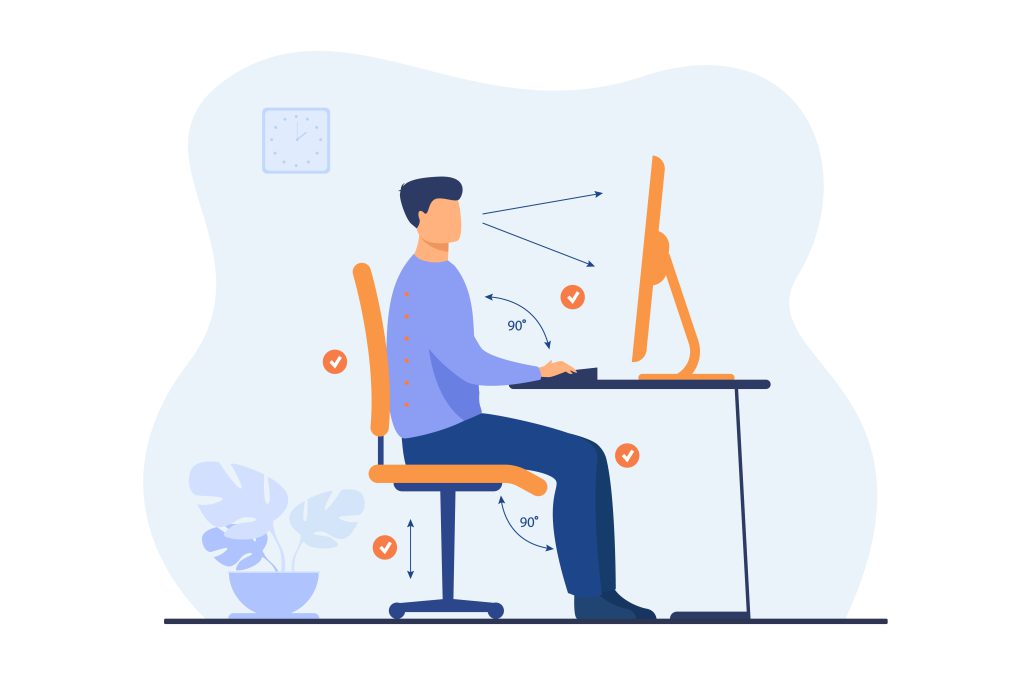
What is posture correction physiotherapy?
It is a structured, non-surgical treatment programme that restores spinal alignment by addressing the soft-tissue and neuromuscular imbalances driving the deviation. It combines four elements:
- Objective postural assessment — plumb line analysis, craniovertebral angle measurement, joint range and muscle length testing
- Manual therapy — spinal mobilisation and myofascial release to restore movement in stiff segments
- Targeted exercise prescription — strengthening inhibited muscles, lengthening overactive ones
- Postural re-education — proprioceptive training and ergonomic correction so the gains hold
The distinction that matters: a brace passively holds you in position while the supporting muscles get weaker. Physiotherapy makes those muscles capable of holding the position themselves.
Postural or structural? The question that decides everything
Before any treatment plan is written, the deviation has to be classified.
Postural (functional) deformity is caused by muscle imbalance, habit and sedentary loading — forward head posture, rounded shoulders, postural kyphosis, anterior pelvic tilt, functional scoliosis. It corrects when you lie down or actively straighten, and it responds well to physiotherapy.
Structural deformity involves bony change — Scheuermann’s kyphosis, idiopathic structural scoliosis, vertebral wedging. It remains visible on forward bending. Physiotherapy manages pain, function and progression here, but does not reverse the shape.
The vast majority of posture problems seen in clinic are functional; the result of eight hours a day at a laptop, not a skeletal defect. Those are the ones physiotherapy genuinely corrects. Any clinic promising to “fix” a structural scoliosis with exercises alone should be treated with scepticism.
Common postural patterns physiotherapy treats
Forward head posture (text neck). The head drifts ahead of the shoulders, sharply increasing load on the cervical spine. Tight suboccipitals, sternocleidomastoid, levator scapulae and upper trapezius; weak deep neck flexors and lower trapezius. Produces headaches, neck stiffness and mid-back burning.
Rounded shoulders and upper crossed syndrome. The classic desk-worker pattern described by Vladimir Janda: tight pectoralis major and minor paired with weak rhomboids, serratus anterior and lower trapezius. Shoulders roll forward and the scapulae wing.
Thoracic hyperkyphosis. An exaggerated upper-back curve. In younger adults it is usually postural and responds to thoracic extension mobility plus scapular and erector spinae strengthening.
Anterior pelvic tilt and lower crossed syndrome. The pelvis tips forward and the lumbar curve deepens into hyperlordosis. Driven by tight hip flexors and erector spinae with inhibited glutes and deep abdominals. Very common in desk workers and postpartum women.
Flat back and sway back posture. The lumbar curve flattens and the pelvis tucks under. This needs the opposite prescription to anterior pelvic tilt which is exactly why self-diagnosis from a video so often backfires.
Functional scoliosis. A lateral curve from leg length discrepancy, one-sided carrying or muscle spasm rather than vertebral rotation. Corrects in forward bending and responds to asymmetric strengthening and myofascial release.
What a posture assessment involves
A proper first consultation takes 30–45 minutes and should include postural photography with plumb line analysis in four views, craniovertebral angle measurement to quantify forward head posture rather than eyeball it, Adam’s forward bend test to separate functional from structural scoliosis, muscle length tests such as the Thomas test, deep neck flexor endurance testing, spinal mobility screening, and a full ergonomic and occupational history.
You should leave that session knowing which pattern you have, what is driving it, and what the plan is. If nothing was measured, you didn’t have an assessment.
Treatment techniques used
Manual therapy and spinal mobilisation restore movement in stiff thoracic and cervical segments, you cannot strengthen your way out of a spine that won’t move.
Myofascial release applies sustained pressure to restricted fascial planes, commonly pectoralis minor, upper trapezius and the suboccipital region.
Dry needling and trigger point therapy deactivate the active trigger points that postural overload creates, reducing the protective guarding holding the faulty posture in place.
Cupping, shockwave and matrix rhythm therapy address chronic myofascial restriction that hasn’t responded to manual work alone.
Kinesiology taping across the scapulae provides tactile feedback during retraining. It’s a reminder, not a corset.
The exercise programme
Exercise is what makes correction permanent, and it progresses in three phases.
Weeks 1–3, mobility and release: thoracic extension over a foam roller, doorway pectoral stretch at three angles, levator scapulae stretch, half-kneeling hip flexor stretch.
Weeks 3–8, activation and strength: chin tucks for deep neck flexor endurance, wall angels for scapular control, prone cobra and prone Y-T-W for lower trapezius, band-resisted rows, glute bridges, dead bug and bird dog for lumbar stabilisation, serratus punches.
Weeks 8 onwards, integration: loaded carries, anti-rotation work, postural endurance holds under fatigue, and a self-managed maintenance programme.
Frequency beats duration. Ten focused minutes daily outperforms an hour on Sunday, because postural change is a motor-learning process, not a fitness one.
How long does posture correction take?
Assuming a functional deformity and reasonable compliance: pain and headaches ease within 1–2 weeks. Visible improvement in resting posture appears at 3–6 weeks. Measurable change in craniovertebral angle and scapular position typically shows by 8–12 weeks, when the new posture starts feeling automatic. Full consolidation takes 3–6 months.
Two things slow this down more than anything else — how long the pattern has existed, and unchanged ergonomics. If your workstation still forces the posture for nine hours a day, no exercise programme wins that argument.
Why posture braces don’t work on their own
Posture correctors are the most-purchased and least-effective intervention in this space. The mechanism is the problem: the brace does the work your muscles should be doing, reducing activation demand on the very stabilisers you need to strengthen. They have a narrow legitimate use as a short-burst proprioceptive reminder alongside an active programme. As a standalone treatment, they postpone correction rather than deliver it.
When to see a physiotherapist
Book an assessment if you have recurring neck or upper back pain every working week, headaches at the base of the skull, visible rounding of the shoulders in photographs, one shoulder or hip sitting noticeably higher, numbness or tingling into the arms, a child with a developing spinal curve, or postural change following pregnancy.
Seek prompt medical review — not just physiotherapy — if postural change comes with unexplained weight loss, night pain that wakes you, fever or progressive weakness.
Frequently asked questions
Can posture be corrected in adults?
Yes. Functional postural deformities respond to physiotherapy at any adult age. Soft tissue stays adaptable throughout life; age changes the timeline, not the possibility. Structural bony changes can’t be reversed, but pain and function still improve substantially.
How many sessions will I need?
Most functional cases need 8–12 supervised sessions across 6–12 weeks, tapering as the home programme takes over.
Is the treatment painful?
Manual therapy and dry needling can cause brief discomfort during treatment and mild soreness for about 24 hours afterwards, similar to post-exercise soreness. Intensity is always adjusted to your tolerance.
Can I fix my posture at home without a physiotherapist?
Mild cases sometimes improve with general exercise. The risk is the wrong programme — anterior pelvic tilt and flat back posture look similar to an untrained eye and need opposite corrections.
Does yoga correct posture?
It improves mobility and body awareness and makes a useful adjunct, but it isn’t diagnostic or targeted, so it rarely resolves an established asymmetry on its own.
Dr. Venkatesh Mishra is a physiotherapist, osteopath and certified dry needling practitioner leading VS Physiotherapy, Osteopathy & Chiropractic Clinic in Kalyanpur West, Lucknow, with extensive clinical experience in musculoskeletal rehabilitation and non-surgical pain management.
If you’d like your posture assessed properly, book a full postural assessment at our Lucknow clinic.
This article is for general information and does not replace individual clinical assessment.